

Written by 
Independent product & compliance insights
Marketplace Dynamics Series
Part 2 of 3 — Delivery structure, performance standards and competitive neutrality.
← Read Part 1: Marketplace Competition: An Australian Seller’s Perspective
← Read Part 3: When the Platform Competes: Buy Box, Data Power and Structural Neutrality
Over the years, we have come to realise that selling the same branded products on the same platform does not necessarily mean competing under the same conditions. In Australia—especially for bulky products like printers—delivery coverage itself can become part of the competitive structure.
A real customer case
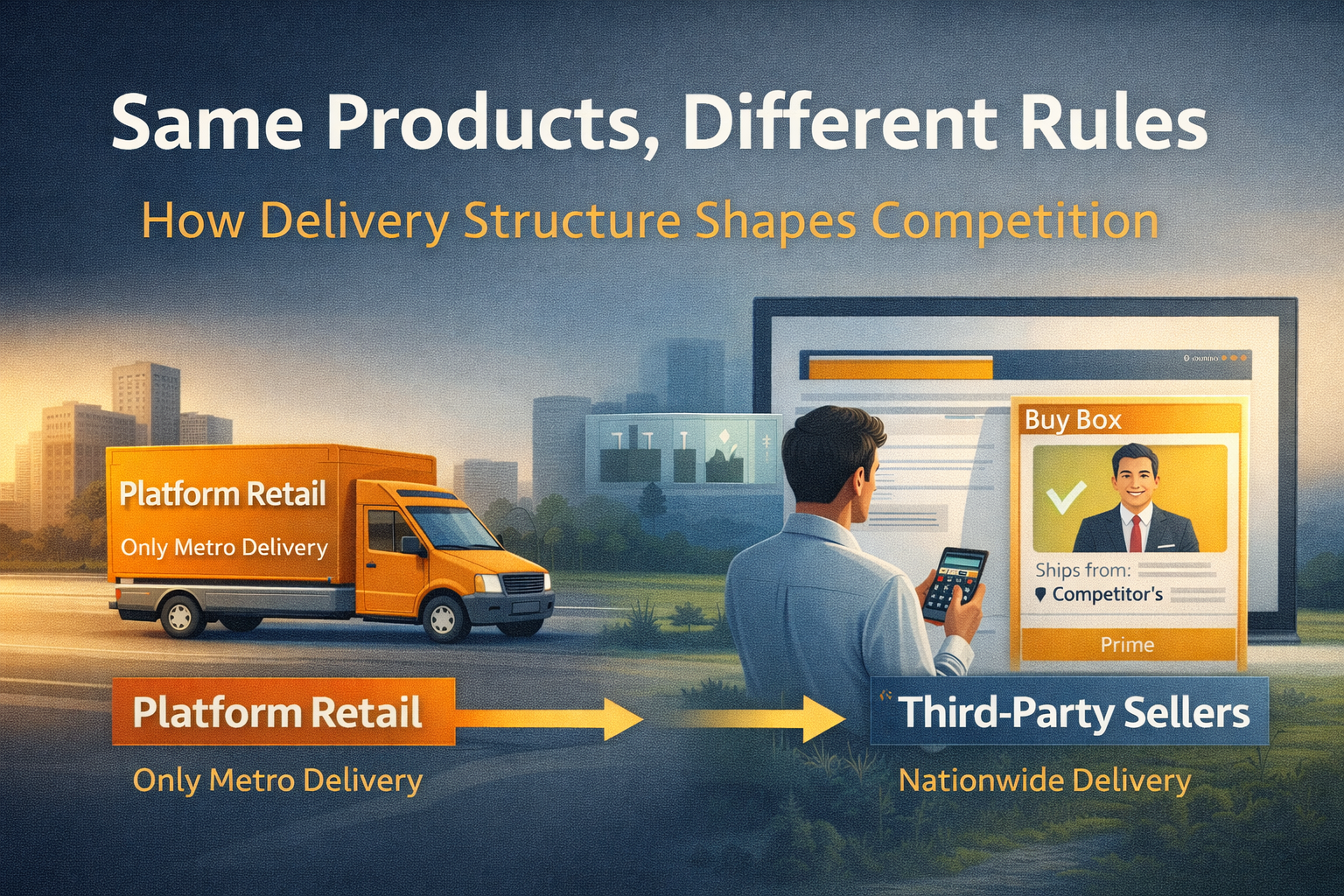
A customer from regional Western Australia contacted us after attempting to purchase a printer listed at $260 on a platform’s retail channel. However, once he entered his postcode, the system indicated that delivery was unavailable.
Shortly after, he placed the order with us instead—at a slightly higher price—simply because we could deliver nationwide, including remote areas. This was not an isolated incident.
For large and bulky items such as printers, delivery coverage itself has quietly become part of the competitive landscape.

Delivery optimisation vs national coverage
In Australia, freight costs for large equipment vary significantly depending on destination. Shipping a printer to NT, regional WA, or Tasmania can add $40–$60 per unit.
For third-party sellers, offering nationwide delivery often means absorbing these costs—sometimes even when margins are already tight. Many sellers can’t selectively exclude regions without impacting account metrics or customer experience scores.
Platform retail operations may optimise differently: focusing on metro areas, prioritising high population density regions, and controlling fulfilment cost exposure. From an operational efficiency standpoint, this is understandable. But when participants on the same platform operate under different delivery constraints, the competitive baseline shifts.

The question is not whether optimisation is necessary.
The question is whether the rules governing participation remain structurally consistent.
KPI standards and performance expectations
Delivery coverage is only one dimension. Performance standards represent another.
Third-party sellers are typically required to:
- Dispatch within strict timeframes (often 1–3 business days)
- Maintain inventory availability
- Protect account health metrics and customer experience scores
Any delay can directly impact ranking and Buy Box eligibility. Yet retail listings may remain visible and occupy prominent placement even when inventory is temporarily unavailable, showing estimated delivery dates of several weeks.
When enforcement intensity differs, even subtly, it alters competitive dynamics.
Trust in marketplace neutrality depends not only on efficiency — but also on consistency.
Structural advantage through SKU design
Another emerging pattern involves differentiated SKU creation. For example, a printer bundled with toner may be listed as a unique package configuration, effectively creating a separate listing that is not readily accessible to other sellers.
Bundling is a legitimate retail strategy. But within a shared-brand environment—where manufacturer products are typically sold through shared listings—structural mechanisms that allow selective exclusivity can reshape competition beyond price and service, and into architecture.

Efficiency vs ecosystem health
None of these observations suggest that efficiency optimisation is inherently wrong. Platforms must improve speed, logistics and cost control to remain competitive.
However, marketplaces are ecosystems. When the platform is both rule-maker and participant, the balance between operational efficiency and structural neutrality becomes increasingly important. Growth alone does not define a healthy ecosystem. Trust does.
Looking for practical help choosing the right printing setup?
Next: Part 3 will explore Buy Box dynamics, listing design and the “rule-maker vs participant” challenge.